Posts

'Free' Wills

Image
Editor's Note: No matter what else is going on in our lives this weekend, a student of history cannot help but be conscious of the boldness of the Declaration of Independence we celebrate today, and how dearly won its principles. There may be other ways to express it, but this weekend I'm going to draw on the perspectives expressed in a prior posting. Whether you remember it or not, I'm hoping you enjoy it - and take it to heart! Over the weekend I reacquainted myself with that episode of the HBO miniseries “John Adams” titled “Independence.” As a writer and editor, I watched with a special appreciation the part where Benjamin Franklin and John Adams are “tweaking” Thomas Jefferson’s draft – and the pain in the latter’s face as his “precisely chosen” words were modified. All in all, a modest sacrifice, to be sure. But I, for one, could feel his pain. That said, anyone who has ever found their grand idea shackled to the deliberations of a committee, who has had to kow...


Graduation “Exhortations”

Image
This past week, my son graduated from high school. It was a big deal for our family, as any graduation would be. However, this was in some ways a particularly special night, since my son is our youngest, and thus—well, it will be our last high school graduation (until grandchildren come along, anyway). The weather chased us inside for the ceremony, which also afforded us one more time to walk the halls that my kids had gotten so familiar with (and which still seem like a maze to me). Mostly, it was an occasion to look back one more time before turning our attention to the future. For me, it was a chance to look back and try to bring to mind my own high school graduation—and all the things that have happened in my life since then. So, for my son—and all the other graduates out there—here are some things I wish I had known when I was your age: If you don’t speak up, people will assume you’re happy with the way things are. If you don’t love yourself, nobody else will. If you wouldn...

All for One?

Image
The underlying theme of last week’s PLANSPONSOR National Conference was “measuring up,” a reference not only to the need to measure the performance and outputs of a retirement plan’s designs, but also to the opportunity to increase and enhance it in the process. Of late, fees are very much on everyone’s mind, as we all prepare for a new series of plan, and ultimately, participant, disclosures. Just ahead of those disclosures, the industry has launched a new generation of plan fee benchmarking services. Each looks at different things, each has its own set of weightings and assumptions, and each draws from a different source. But for my money, here are 10 things you should know about any service that purports to help you benchmark your plan: What is the source of the database that serves as a point of comparison? Is the database itself large enough to be relevant? Does it include relevant points of comparison with your program in terms of plan size, industry, and/or geographic loca...

Chances Are…

Image
I’ve long adhered to the wisdom of having a “Plan B,” a fallback position if the things you hope will work out—don’t. Now, sometimes those fallbacks aren’t completely well-formed (ask my wife), but to my way of thinking, assuming that everything will work out “according to plan” is just tempting fate. When it comes to saving for retirement—or, more accurately, to having enough saved for retirement—workers have long had a set of “Plan Bs,” though not always completely well-formed, to put it mildly. They have assumed that if they weren’t saving enough at present, they would “catch up” by saving more “later”; they have assumed market returns to grow their accounts that defied reality (if not common sense); and some have gone so far as to assume they had a pension coming in situations where it was clear that no such safety net would be present. 1 And then, this past week, a study published by the Employee Benefit Research Institute (EBRI) threw cold water on what has, IMHO, been a “bes...

Commit, Meant

Image
Much to my surprise, my son went to prom this weekend. Now, I realize that a lot of kids go to prom—and I also realize that more don’t go than is generally appreciated by those who do. But my son, who at present isn’t in a relationship (and certainly not one serious enough to make prom attendance a “requirement”), has long been of the mindset that prom was just a lot of “bother,” and an expensive bother at that. Having committed himself to this event, however, we of course had to contend with all those things that constitute that “bother”: renting a tux, selecting flowers for his date, etc. Later there emerged items like the expectations around the table at which (and with whom) he and his date would sit and the gathering(s) beforehand—and afterwards. For the very most part, he dealt with each new “decision” calmly, though as time went on, you could see him taking deep breaths as he contemplated just how much more of this “bother” he would have to endure (girls seem to have a lot mo...

London “Bridges”

Image
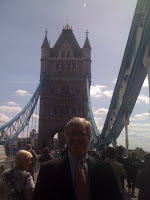
I was in London for a few days last week, and while it afforded a good opportunity to visit with a number of providers in the European retirement plan market, the primary purpose of my trip was to acknowledge the fund manager and consultant standouts recognized by PLANSPONSOR Europe (which has just celebrated its one-year anniversary). The luncheon itself was fascinating: As is often the case with such gatherings here, many of the attendees were well-acquainted with each other, a number had common employment histories and, as in the U.S., even those who worked for competing firms at the moment seemed to sense that it could change at any time. Once we got past the potential impact of the latest Icelandic volcanic ash cloud, the traffic disruptions attendant with President Obama’s visit (which, of course, had been impacted by the latest Icelandic volcanic ash cloud), and the beautiful weather (which, fortunately, was apparently completely unaffected by the latest Icelandic volcanic ash c...

Loan Arranging

Image
The headlines last week were all about how new legislation had been introduced to cut down on the “leakage” from 401(k) plans. That leakage, roughly defined as pulling money out of retirement savings before retirement, has been a concern of many for some time. About once a year, someone puts out a report about the number of outstanding loans from these programs and/or the uptick in hardship withdrawals (see IMHO: Double Dipping ) ; and, from 2008, see IMHO: Safety “Net” ). Not surprisingly, with the sluggish U.S. economy and the so-called jobless recovery, people seem to be dipping into these accounts at higher rates. And yet, for all the hyperbole around such things, the actual rate seems to be pretty consistent (allowing for differences in the data samplings). That said, last week, Senators Herb Kohl (D-Wisconsin) and Mike Enzi (R-Wyoming) introduced the Savings Enhancement by Alleviating Leakage in 401(k) Savings Act of 2011 (the SEAL Act), which, among other things, was designe...

Change Parse

Image
Three things every adviser (and provider) wishes plan sponsors understood about recordkeeping conversions: Everybody wants to change providers on January 1. Everybody can’t. If your plan year end is December 31 (and it is, for the vast majority of plans), there are some real benefits to making a provider change at that point in time. Plan reporting—both participant and regulatory (Form 5500)—is quite simply neater when you finish the reporting year at the same time you conclude your arrangements with a provider. Anything else is going to require someone somewhere to “splice” together reports at some point. Doing so doesn’t have to be a big deal—but it can be “awkward.” There are some reasons not to make those kinds of changes at year-end, of course. First off, there’s generally quite a queue wanting to do so. You may well be able to get in that queue, but your new provider will likely have their hands full with a lot of plans just like yours. More significantly, your soon-to-be...

Out of Proportion

Image
Without question the retirement plan industry has prospered from the long-standing practice of relying heavily – and in some situations, completely - on asset-based fees. Now, you can certainly argue that that has resulted in plans paying for services they would not otherwise have engaged, and that it has, in some cases, led to plans paying more than they might if they had been more cognizant of the dollars expended. Indeed, one can argue that the imbedding of those fees inside the fund structure has made it easy, perhaps too easy, for the industry to collect its tolls without drawing the kind of scrutiny they were entitled to. On the other hand, that structure has made it easier for the industry to provide a broad-based level of sophisticated services to plans of all sizes, and has doubtless made it possible for plans to contemplate hiring an adviser that, regardless of the need and/or benefit, would otherwise have been discouraged by an explicit charge for those services. That said...

The Enemy of the Good?

Image
Over the past couple of years 401(k) evaluation service BrightScope has made quite a splash. Early on, most folks I spoke with were quite keen on what was being undertaken by the firm. 401(k) fees were unfortunately still mystery meat to many plan sponsors, and thus a service that purported to help them make sense - not only of what they paid, but how it compared to other programs - looked to be a godsend. As time has worn on, there have been questions and concerns. The data that underlaid Brightscope’s computations was drawn from government files – and while that made it “official”, it apparently didn’t always mean it was accurate, and it surely didn’t make it timely (though the latter is getting better all the time). Moreover, BrightScope employs a proprietary methodology that relies on certain weightings and assumptions that not everyone would agree with – but then, it’s a proprietary methodology, after all. If you don’t like it, or don’t think it does a fair job of representin...

“Smoke” Signals

Image
Plan sponsors spend a lot of time wondering—and worrying—about the “right” way to do things. They rely on the guidance of experts, the insights of publications like ours, the black—though often gray—letter of the law, and sometimes they must rely on the occasionally contradictory adjudications of the courts. Those contradictions have been much in evidence in the series of 401(k) revenue-sharing lawsuits, which, IMHO, continue to suffer from what seems to be a confusing “flexibility” in judicial discernment regarding the standards of fiduciary responsibility and application of ERISA’s 404(c) safe harbors. In fact, it is only a matter of time until some plan sponsor somewhere files an injury claim for whiplash incurred from simply trying to keep up with the direction of these decisions. The most recent example was the case of Gerald George vs. Kraft Foods Global (see Appellate Court Sends Back Kraft Fee Case ), a case the 7th U.S. Circuit Court of Appeals remanded (albeit in a split ...

Rest “Room”

Image
It should come as no surprise that the vast majority of plan sponsors who have adopted automatic enrollment have chosen to default that initial deferral at 3% of pay. No, that’s not the level at which most plans match deferrals, and it’s certainly not a level of deferral likely to produce sufficient retirement savings. It is, however, the starting deferral rate attributed to such programs under the auto-enroll safe harbor provisions in the Pension Protection Act (PPA). Coincidence? I think not. Ironically, that same safe harbor provision requires that employers either go back and automatically enroll all eligible participants (giving them the ability to opt-out), or be able to establish that they did at some point (see “ The Pension Protection Act: This Changes Everything ”). Most providers, certainly pre-PPA, were unable to provide the requisite proof of those prior enrollments—and thus it would seem that most employers seeking the protections of that auto-enroll safe harbor woul...

Expert Opinions

Image
I learned a long time ago that when it comes to things like automobile maintenance, home repair, or gardening, I’m better off hiring an expert. Now, I have friends who derive great pleasure from things like “puttering around” in the backyard, who relish the accomplishment of laying down their own carpet or wallpapering a bathroom, who derive great satisfaction from installing their own car stereo or home entertainment center. But as for me, I’m happy to support our nation’s economy by paying someone who actually knows how to do such things. It’s not that I CAN’T do those things, mind you—it’s just that they take time I don’t have to do things I’m not good at for a final result with which I am never completely satisfied. And, if I’m honest, because I don’t like those tasks, I put off doing them—as long as humanly possible. One of the most common information requests I get from advisers is help in proving to sceptical plan sponsors that they should hire an adviser. While I don’t a...

Mixed Messages

Image
We had wrapped up a very successful half-day adviser event ahead of our annual Awards for Excellence dinner last week. As we closed up the session, a co-worker of mine commented to me as an aside, “Nobody ever told me I needed to be saving 12% before.” Now, this co-worker has nothing to do with our magazines, or the content that fills our Web sites and newsletters. He just happens to work at a company that, among other things, publishes information about retirement plans. He’s a participant in our benefit plans, of course—and so he has probably been exposed to all the same types of education and savings materials as anyone (perhaps more). He’s a smart guy (he’s pursuing his MBA at night), tech-savvy, and he pays attention. And yet, it wasn’t till he was effectively sitting there as a fly on the wall in a room full of the nation’s best retirement plan advisers that he overheard someone put forth a specific savings-target figure. Now, like any good plan sponsor, I can explain that. ...

Comparison “Points”

Image
Every year about this time, we get reports from firms that purport to tell us how much time is spent in preparations for the NCAA basketball tournament—and, no, not by the teams and coaches. The “studies” (ironically, they’re always put out by firms that are in the business of helping people find jobs) generally make some assumptions about the amount of time people spend on the workplace pools as well as how many people will participate, and their compensation levels, and—voila—the productive time ostensibly “lost” to these activities. Now, they make a lot of assumptions to get to that result, including the assumption that, but for these pools, people would be doing nothing but working. But the results give journalists something easy—and “fun”—to write about, and the rest of us to read and talk about (some day someone should do a study on how much time and money is wasted writing and reading about those “studies”). Our lives are filled with such reports: perhaps valid points that are...

Court Costs

Image
Last week brought to light an aspect of 401(k) litigation that doesn’t generally get a lot of coverage—and the participant-plaintiff was presented with a $50,000 bill. Now, at some level, this case was “just” another stock drop suit where some kinds of accounting issues contributed to a sudden (and ostensibly unexpected) drop in the price of company shares, including those held in the company’s 401(k) plan.1 These types of cases have cropped up one after another in the wake of the market downturn, and while the fact patterns behind the drop in share price vary slightly, the suits themselves allege pretty much the same thing: The plan fiduciaries kept the stock as a plan investment after it was no longer prudent to do so; to wit—after it suffered a precipitous drop in value. Most of these cases don’t seem to get very far, the courts either deferring to a “presumption of prudence” (see “IMHO: Prudent Mien?” or, as in this case, finding that ERISA 404(c)’s safe harbor provided shelter ...

“Conversation” Starters

Image
There’s been a lot of talk coming from Washington of late about the need to have “an adult conversation” with the American people. That conversation ostensibly includes discussion around the need to make changes to how this country spends its money and/or how much it needs to fund that spending. Almost certainly that “adult” conversation means decreasing entitlement benefits and/or increasing the tax “contributions” we make to fund those entitlement benefits. The politicians wonder if we’re ready for it; personally, I think the politicians are the only ones who aren’t. Still, when someone talks about the need for an “adult” conversation, what they mean is that we need to talk about things you’d probably just as soon not think about, much less talk about. Those are generally serious topics with painful choices. Regardless, we’re only just beginning to have those “adult conversations” with retirement plan participants. Sure, we talk about the need to save as much as they can, beginn...

Underlying Assumptions

Image
Last week the Government Accountability Office (GAO) issued two reports focused on 401(k) plans: one on target-date funds, the other on potential conflicts of interest. As seems to be its custom in such reports, the GAO communicates its conclusion in the titles: “Key Information on Target Date Funds as Default Investments Should Be Provided to Plan Sponsors and Participants” and “Improved Regulation Could Better Protect Participants from Conflicts of Interest”—and, IMHO, there’s little controversy in those statements. The reports themselves offer a great informational primer on target-date fund designs and issues (you’d be surprised how many plan sponsors still don’t quite grasp the concept of “glide path”) as well as the fee structures and revenue-sharing components that underlie the 401(k) retirement savings system. Both reports acknowledge that efforts are already under way to remedy the shortfalls the reports identified in both, while at the same time promoting solutions to those...

Hire Powers

Image
One of the first things you learn in any kind of ERISA primer is that, as a fiduciary, you are expected to conduct yourself either as if you are an expert, or hire someone to help you who is. This so-called “prudent expert” rule is, of course, a significantly higher standard than the one applied to mere common- law fiduciaries—in fact, it is generally described as the highest legal standard. Of course, plan sponsors have long relied on the help of experts—attorneys, third-party administrators, investment managers, and recordkeepers—if only because so much of what a plan sponsor must do in operating their retirement program requires their active involvement. Not so retirement plan advisers, who, for many plan sponsors, remain something of an optional enhancement to their program. That said, in an environment that remains a legislative, regulatory, and operational thicket for even the most active and engaged plan sponsor, it is a plan option that is rapidly becoming standard equipmen...