Posts

Showing posts with the label RCS

Retirement Realities

Image
Are you confident about your retirement finances? Apparently, and despite responses that undermine a rational level of confidence, many are. Last week, the Employee Benefit Research Institute (EBRI) and Greenwald Research unveiled their 34th annual Retirement Confidence Survey (RCS) . Now, I’ve commented previously about the dubious conclusions one can draw from personal sentiment surveys, not to mention those personal assessments of wealth and needs. Those limitations notwithstanding, over the years, the Retirement Confidence Survey has helped uncover a number of interesting and intriguing perspectives about retirement, real and imagined―and no small number of what would appear to be unrealistic expectations about retirement: expectations around how long individuals think they will be able to work, for example, or that they will be able to work for pay after retirement. Additionally, there have been indications that more individuals expect to receive a pension than would be suggeste...

The Fear of Finding Out

Image
I hadn’t been to the dentist in a long time. A VERY long time. Two weeks ago, and at the encouragement of my wife, I finally went back to the dentist. I hadn’t been since COVID, and that period provided a very good excuse for avoiding that visit. Turns out, I hadn’t been for quite a while before COVID—not so much intentionally, just life getting in the way. That’s not completely accurate, of course. On the best of visits, trips to the dentist had never been exactly “pleasant,” though I’ve been fortunate to be in the hands of friendly, patient and—gentle—staff over the years. That said, my last visit had involved what wound up being a unexpected and relatively involved procedure that, while it remedied a painful (and potentially dangerous) situation, left me with a certain, shall we say, “fear of finding out”… Now, avoiding the dentist didn’t prevent problems, of course. And many’s the day over the past several (gulp!) … years when I would tell myself that it would be b...

The Sure Not-So-Sure Thing

Image
By some accounts, I just spent the past week in “retirement”—driving around sightseeing, reading some good books, hanging out with family, and yes—even walking on a beach. And I have to tell you—if that was retirement, I don’t know how I’m going to afford it. Now, I realize that isn’t the stuff of most “real” retirements, though it is frequently the stuff of retirement planning brochures. My week was a family vacation, and it was spent doing the things that families do on vacations. [i]  And it served as a stark reminder that while sitting on a beach doesn’t cost much, making arrangements to stay—and eat—in proximity to the aforementioned beach is a whole other financial consideration. That said, when those actually  in  retirement are asked about their retirement confidence—well, it’s pretty high. According to the Employee Benefit Research Institute/Greenwald Associates annual  Retirement Confidence Survey , 77% of current retirees report feeling eit...

That Sinking Feeling?

Image
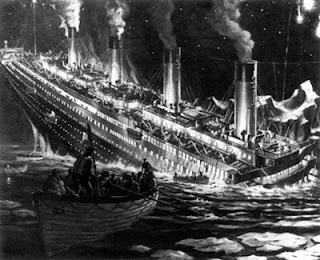
You may have missed it – but we just passed the anniversary of the 1912 sinking of the now iconic RMS  Titanic , at the time the world’s largest ocean liner. Its passengers included some of the wealthiest people in the world, as well as a large number of emigrants seeking a new life in North America. On the ocean liner’s maiden – and only – voyage, it carried 2,244 people, 1,514 of whom would perish in the North Atlantic. In hindsight, the  Titanic  seems a textbook example of a disaster that could have been avoided: There were plenty of warnings about sea ice (as many as six), but the ship was traveling near her maximum speed (though it’s a movie myth that they were trying to set a speed record) when lookouts sighted the iceberg that did her in with a “glancing” blow – that nonetheless opened 6 of her 16 compartments to the sea (the ship was designed to stay afloat with four of her forward compartments flooded). And let’s not forget that she went to ...

4 Retirement Savings Benchmarks That (Generally) Miss the Mark

Image
Behavioral finance tells us that human beings are prone to relying on heuristics – mental shortcuts, if you will – to solve complex problems. While these may not be very accurate, survey data and anecdotal evidence suggest that participants often rely on these benchmarks. Here are four that workers use more often than we’d perhaps like to admit. The Company Match Survey data and academic research have long suggested a link between the employer match and the level to which workers contribute. Indeed, there has been evidence (frequently invoked by advocates of the so-called “stretch” match) that it’s not the amount of the match that motivates, but the existence of the match at any level. There is, in fact, evidence that a lot of people save only as much as they need to receive the full employer match (unfortunately, there’s also evidence that many don’t take full advantage – particularly lower income workers – and confusion about how ...

5 Ways to Boost Retirement Confidence

Image
With increasing regularity, the financial services industry pumps out surveys that purport to capture America’s sense of confidence regarding its readiness for retirement, at least on a financial footing. Mostly, however, they seem to focus on the symptom, rather than dealing with the underlying cause(s). However well-intentioned, these all seem designed to highlight a persistent strong undercurrent of concern — one that, certainly when juxtaposed against the generally disappointing preparation levels reported by respondents, seems completely warranted. Confidence about retirement is one thing, of course, and preparation something else, though the two are logically intertwined. That said, for those looking to shore up confidence levels, data from the granddaddy of such surveys — the non-partisan Employee Benefit Research Institute’s (EBRI) Retirement Confidence Survey — provides a roadmap: Work for an employer that offers a retirement plan. Data indicates that workers — even wo...

"Working" Capital

Image
In response to concerns that tomorrow’s retirees will run short of money, we are often told to save more, to work longer, or — as often as not these days — to work longer and save more. Certainly working and saving longer can do wonders in terms of stretching your retirement nest egg. It should probably come as no surprise that American workers are expecting to work longer. The Retirement Confidence Survey notes that in 1991, just 11% of workers expected to retire after age 65. This year that was up to 33% of workers, and another 10% who said they don’t plan to retire at all. However, the timing of the retirement decision is often not within an individual’s control. A recent survey conducted by Merrill Lynch and Age Wave found that a majority of retirees surveyed (55%) say they retired earlier than they had expected — just 7% later than they expected. Similar trends were found in EBRI’s 2014 Retirement Confidence Survey (RCS), where while more than one-in-five (22%) of workers ...

Look-Back "Provisions"

Image
My wife and I recently celebrated our wedding anniversary.  It was a special day, as they all are, but as I thought back on the events of our life together, I was struck by the realization that I have now been married for about half my life.  Not that I didn’t expect to remain married, or to live this long; if someone had asked on my wedding day if I thought I’d still be alive and married this many years hence, I’m sure that I would have expressed confidence, likely strong confidence, in both outcomes.  However, if someone on that same day had asked me to guess then where I would be living now, what I would be doing, or what my income would be (or need to be)—well, my responses would likely have been much less certain. In just a few weeks we’ll be making preparations to launch the 2015 Retirement Confidence Survey (RCS) [i] .  It is, by far, the longest-running survey of its kind in the nation.  Indeed, this will be its 25 th year.  Think for a moment ...

”Background” Check

Image
We’ve never invested in a vacation home, but for a number of years now, my family has made relatively regular trips to Gettysburg, Pennsylvania. And while we’ve visited many places over the years, Gettysburg remains special, both because there are places that we know, and have visited many times, and because there are (still) things to discover. Over time we’ve also shared that experience with friends and members of our extended family, and their participation adds an additional, fresh perspective, even to sites we have visited many times before. On March 18, EBRI and Greenwald & Associates will release the results of the 24 th annual Retirement Confidence Survey (RCS). With a perspective longer than many retirements, it’s likely to garner a lot of attention, as well it should. The focus tends to be on retirement confidence (or the lack thereof), specifically at the extremes—those “very” and “not at all” confident in their prospects for a financially comfortable retirement. ...

Believe Able

Image
In that holiday classic “Miracle on 34th Street,” a man named Kris Kringle (who claims to be “the one and only” Santa Claus) winds up having his sanity challenged in court. Ultimately, the judge dismisses charges that would have resulted in Kringle’s institutionalization—not because he actually is persuaded to believe by the evidence that Kris is the REAL Santa Claus, but because he finds it convenient to demur to the determinations of a higher authority (in this case, the US Postal Service). While belief may not always be a portent of reality, it can be a powerful force, as any parent who has ever nurtured Santa’s existence well knows. The 2013 EBRI/Greenwald & Associates Health and Voluntary Workplace Benefits Survey¹ (WBS) reveals that most workers believe their employers or unions will continue to provide health care insurance— although there have been employer surveys indicating that, at some point in the future, some may not. Not that workers fail to appreciate future u...

Thinking "Caps"

Image
In this era of “reality” TV, where the “antics” (and worse) of the formerly rich and infamous are on display in ways that could not even have been imagined a decade ago, I seem to find myself increasingly shaking my head and muttering “what were they thinking?” The answer, as often as not, seems to be “they weren’t.” And some, looking at the retirement savings behaviors and expectations of the American workforce over the years, might well wonder—and perhaps respond—the same way. Whether you are an employer trying to motivate workers to avail themselves of a new benefit (or to better utilize an existing one), an advisor looking to improve their portfolio diversification, a provider interested in expanding acceptance of your product set, or a regulator trying to fine-tune (or overhaul) the current legal boundaries, sooner or later you find yourself wanting (perhaps NEEDING) to know “what are ‘they’ thinking?” In just a few weeks, we’ll begin development of the 24th Retirement Con...

(Un) Realistic Expectations

Image
This past weekend I joined the throngs of humanity that went to the theaters to see Iron Man 3. I grew up reading Marvel Comics, and, for the very most part, seeing those characters brought to life on the big screen has been a real treat. I had been curious about the new Iron Man movie for some time, but wasn’t sure if it could live up to expectations based on the prior films. It’s hard to escape the endless promotions for these summer blockbusters, but I made a conscious effort to do so, and even avoided reading the reviews of the film until after I had had a chance to see it for myself. That decision involved some financial “risk” as anyone who has taken a family to the theater recently can attest. There have, however, been disappointments along the way―sometimes the acting was bad, sometimes the storyline was (unintentionally) laughable, and sometimes the movie fell short of what I had anticipated simply because my expectations were set so high. Over the years, the Retiremen...

“Show” Time

Image
Though there’s precious little worth watching on television these days, I’ll confess to having developed a fondness for the Sunday night shows that have sprung up all over cable television—series like Downton Abbey, Mad Men, Hell on Wheels, and yes, The Walking Dead. These not only keep me up on Sunday nights, but looking forward to the end of the weekend. The “hiatus” gaps between these cable seasons are long enough that it can be hard to remember where the story line left off, though these days the standard seems to be to pick up the characters’ lives at a different point in time. Downton Abbey closes one season at the start of WWI, and opens the next in the middle of that conflict, for example—or Mad Men closes a season with the key characters having decided to split off from a stifling new British parent firm, and the next season opens with their new venture already operating as a full-fledged advertising firm. These storyline “jumps” can be a bit disorienting, but time (and th...