Posts

Showing posts with the label education

Financial Literacy — A Skeptic’s Perspective

Image
   It’s an odd thing to admit in Financial Literacy Month — but I’ve been a financial literacy skeptic.  Not always, of course. Once upon a time I was one of those industry voices decrying the burden placed on employment-based retirement plans. Employers (and advisors) who — in the course of a 25-minute workshop — had to convey the range of concepts required to make knowledgeable investment decisions to an audience of adults who had never been exposed to any of that prior to that session. Considering all the (relatively) useless things that ARE mandated in school curriculums, some basic finance concepts seemed like a pretty reasonable “ask.” State Steps And though it’s been a long time coming, a number of states [i]  now do require students to take a financial literacy course for high school graduation — and that number continues to climb. That said, what constitutes complying with that requirement — varies. And, if it’s like a lot of the classes I was required to ta...

The Need to 'Know" Basics

Image
Back in the middle of the pandemic, my then 91-year-old mother was presented with two options—one a specialist recommended, the other favored by her trusted general practice physician. And of course, it was to be…her decision. This kind of thing happens all the time in the medical field where such things often seem as much art as science, with a myriad of factors to consider, not the least of which is the skill and experience of the medical professionals putting forth their recommendations. Not that it’s limited to life-and-death decisions. Indeed, it’s the kind of decision with which we’re often presented; when that annual auto inspection detects a hitherto undetected major repair need, when that leaky toilet repair uncovers some long-standing, but unobserved water damage, when that last minute call to fix a water heater or air conditioner reveals that it might—but might not—last the season. Those things routinely involve experts of one sort or another turning to us re...

Advisor Value ‘Adds’

Image
 Most of the attempts to affix a value to having an advisor tend to focus on investment returns or cost savings. Both are valid, objective measures that can have a real, substantive impact on retirement security—but, at least with the best advisors—there’s usually more. Indeed, years ago as a fiduciary of another firm’s 401(k) plan, and while I had always felt comfortable with the decisions the plan committee had made, as our little company grew to be less little, I was increasingly aware of the personal liability associated with my role, and the small amount of time I was able to dedicate to the task alongside my “day job.”  That advisor delivered in all the ways I had hoped he would—but there was value well beyond that in terms of the structure he brought not only to our discussions, but to our process. Things like: The Discipline to Meet Internally driven committee meetings are frequently a casualty of whatever crisis emerges on any particular day. As huma...

Things You Don’t Learn in School

Image
 Life has many lessons to teach us, some more painful than others—and some we’d just as soon be spared. But the graduates of 2021—well, they’ve been through a lot, arguably more than most—but with any luck at all, the days and years ahead will be brighter.  Regardless, if you have a graduate—or if you  are  a graduate, here are some insights I’ve picked up along the way…    ASAP is never as soon as people think. Even those who work for themselves have bosses (they’re called “clients”). Emails (generally) don’t have to be answered right this minute. Bad news doesn’t improve with age. Your first job can be like your first love—it will either bring a smile for years to come—or it can break your heart. And sometimes both.   Don’t expect your job to respect personal boundaries without some “help.” Don’t be afraid to pick up the phone. If the only time your boss hears from you is when there’s trouble, don’t be surprised if the...

Education Precedents

Image
I’ve been working with retirement plans for my entire professional career, during which I have met, spoken with, and written to tens of thousands of plan sponsors. And yet, in all that time, and with all those people, I’ve not met more than a handful who had chosen that specific role as a career path. More often than not, they’ve found themselves in that role with no training, education or background in the role beyond an out-of-date plan document and the cryptic notes left behind by a harried predecessor. Indeed, there’s more than a bit of irony that individuals who find themselves in a job with personal liability for their actions (and the actions of their co-fiduciaries), alongside an expectation of prudence that courts have described as the “highest known to man,” have had little in the way of practical, retirement-plan-focused training. That’s a problem for those plan sponsor fiduciaries, of course, but also for the plan advisors who support them. While...

Returns “Engagement”

Image
An acquaintance of mine once remarked, “you can’t solve a savings problem with investment returns.”   Yet, participants frequently focus on the returns of their retirement savings investments. Consider that during the month of May, major stock indexes like the Dow Jones Industrial Average and the S&P 500 were off 6 percent. But, according to an EBRI analysis, the estimated average 401(k) account balance 1 was down less than 3 percent during that same month, both due to the inflow of ongoing contributions and more diversified portfolio holdings. That determination is based on estimates from the EBRI/ICI Participant-Directed Retirement Plan Data Collection Project—the largest, most representative repository of information about individual 401(k) plan participant accounts. In fact, as of December 31, 2010, the EBRI/ICI database included statistical information on about 23.4 million 401(k) plan participants, in nearly 65,000 employer-sponsored 401(k) plans, representing $1.41...

State “Capital”

Image
I recently had the opportunity to attend The National Financial Capability Study Roundtable, where a variety of researchers (including EBRI’s Sudipto Banerjee) presented, discussed, and challenged a variety of research papers on topics ranging from financial literacy and retirement planning to financial advice, and from financial literacy and financial behavior to “Prohibition, Price Caps and Disclosure”.   Taken as a whole, the day’s discussions focused on ways to better understand and measure the factors that appear to influence individual behaviors regarding their finances.   Simply stated, financial literacy is generally described as the ability to understand finance.   More recently, some have begun to focus on financial capability 1 .   Research has shown that people with higher levels of financial literacy approach retirement with much higher levels of wealth.   However, a growing body of research also suggests that most Americans have limited kno...

IMHO: Catching Your Drift

Image
I recently found myself driving in an unfamiliar city without the aid of a GPS (global positioning system). Sadly, I had become so accustomed to having that device available, I hadn’t even taken the time to print out instructions from any of the usual Internet sources, and while there were maps in the vehicle, none were of the area in question. That didn’t matter, I told myself—because I had made that drive before, had a pretty good idea of where I needed to be and, armed with a pretty reliable memory for such things, I set out with only a little trepidation. Just about the time I was getting pretty confident in my ability to navigate without all the high-tech “crutches,” I was thrown a series of curves. The primary route was closed due to construction, the rerouting didn’t seem to take into account where I was trying to get to, an unexpected one-way street suddenly emerged going the “wrong” way, and then I found myself directed onto a parkway whose designers had apparently never co...

The IKEA “Experience”

Image
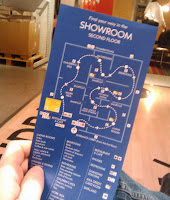
We spent some time this past weekend getting my eldest daughter squared away in her new apartment. It’s her first, and as with nearly all first apartments, there is a lot you need to get that you never needed in your room at home or in your dorm away at college. So we headed out to IKEA. Those who have never had occasion to visit an IKEA store should check it out at least once. They are mammoth stores—big on the outside and seemingly even more massive on the inside. It’s the kind of store you can easily get lost in (not to worry, they have their own food court inside), and yet it’s very hard to simply get from point A to point B, even if you know what you want to buy. About the only way to get through the store is to wander along the winding path the IKEA folks have constructed that takes you—literally—through every display imaginable.1 But the really interesting thing about the IKEA shopping process is that you not only have to find what you want, you must write down the part n...

Hurricane Forces

Image
It’s been a stressful week—and it’s not over yet. Over the past 10 days, I’ve managed to survive three college move-ins, an earthquake in our nation’s capital and—with a little luck—a hurricane bearing down on the Northeast even as I write this column. Now, I know it’s summer—Labor Day is only a week off—and there’s a lot looming over our industry’s head, but the fact is, I am—perhaps like many of you—having trouble focusing on anything other than Hurricane Irene. See, we live in a neighborhood that seems particularly prone to losing power, and we’re frequently the last in our town to have it restored—and that’s when we don’t have a hurricane sweeping the Eastern seaboard! It’s bad enough to be without power for several days, but the last time it happened, it was accompanied by some significant rainfall, and we quickly found out (the hard way) that the sump pump that normally keeps that extra water from pouring into our basement requires electricity to function. Fort...

What Lies Ahead - Part 2

Image
If 2010 was not quite the return to “normal” we might have hoped, there was more than enough—both new and old—to draw the attention of plan sponsors. Here is the second part of our look at the trends that were on our mind this past year—and those just over the horizon. Stop Gaps: Closing the Pension Funding Gap What we said last year : It remains more expensive—and complicated—to walk away from pension commitments than most realize, though many employers remain committed to their pension plans for reasons that transcend those financial considerations. Still, it seems likely that freezes, both hard and soft, will continue to be applied, certainly in the private sector. The public sector’s commitment to pensions remains largely unabated—and yet, a sense remains that it may only be a matter of time before fiscal realities bring about a different result. Where we are : For the very most part, little has changed. Pension funding remains a challenge, with the funding gap seemingly cons...

The Measure of the Plan

Image
Not so long ago, plan sponsors gauged the success of their defined contribution offerings by a single metric: participation rate. It’s not that they didn’t pay attention to other criteria, but participation rate is objective, easy to calculate, and, certainly for a voluntary savings program, it’s not an inappropriate gauge of the program’s perceived value. Over the past couple of years, a growing number of plan providers have brought to market a new set of plan diagnostic measures, measures that not only show individual and plan balances, but also project those balances out to an estimate of what those balances will provide in retirement income, or presented as a measure of retirement readiness—compared with an established level of income replacement. It’s not a new idea, of course. Heck, there has even been legislation introduced to place—on participant statements—a projection as to what the participant’s monthly retirement income would be. Meanwhile, despite long-standing fears th...

Thanks Giving

Image
Thanksgiving has been called a “uniquely American” holiday, and one on which, IMHO, it is fitting to reflect on all we have to be thankful for. Here's my list for 2010 : I’m thankful that the vast majority of plan sponsors continued to support their workplace retirement programs with the same match and options as they had in previous years—and that so many of those who had to cut back in 2009 made the commitment to restore some or all of it in 2010. I’m thankful that participants, by and large, hung in there with their commitment to retirement savings, despite the lingering economic uncertainty. I’m especially thankful that many who saw their balances reduced by market volatility and, in some cases, a reduction in their employer match were willing and able to fill those gaps, in most cases by increasing their personal deferrals. I’m thankful that most workers defaulted into retirement savings programs tend to remain there—and that there are mechanisms in place to help them save ...