Posts

Showing posts with the label titanic

That Sinking Feeling?
Image
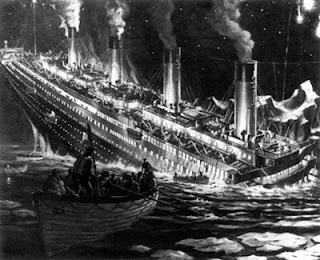
You may have missed it – but we just passed the anniversary of the 1912 sinking of the now iconic RMS  Titanic , at the time the world’s largest ocean liner. Its passengers included some of the wealthiest people in the world, as well as a large number of emigrants seeking a new life in North America. On the ocean liner’s maiden – and only – voyage, it carried 2,244 people, 1,514 of whom would perish in the North Atlantic. In hindsight, the  Titanic  seems a textbook example of a disaster that could have been avoided: There were plenty of warnings about sea ice (as many as six), but the ship was traveling near her maximum speed (though it’s a movie myth that they were trying to set a speed record) when lookouts sighted the iceberg that did her in with a “glancing” blow – that nonetheless opened 6 of her 16 compartments to the sea (the ship was designed to stay afloat with four of her forward compartments flooded). And let’s not forget that she went to ...

4 Reasons Why an Average 401(k) Balance Doesn’t ‘Mean’ Much

Image
In recent days, we’ve gotten updates on average savings rates and 401(k) balances, and while for the very most part the reports have been positive and “directionally accurate,” I’ve always taken such findings with a grain of salt. Not so many in the press. Indeed, the press coverage of those reports is generally quite negative, in the “how can people possibly retire on those small amounts” vein. Here are four things to keep in mind about those “average” 401(k) balances. Your average 401(k) balance may not be based on very many plans or participants. Some reports of plan design trends and average balances may do so based on a relatively small customer base, and/or homogenous plan size. That doesn’t mean the results are without value – but let’s face it, sample size matters in discerning trends. The average 401(k) balance in a universe of 50 plans is surely less instructive than one that is a hundred times that size. In all surveys, sample size matters. And when it comes to avera...

Are SDBAs the Next Litigation Target?

Image
Back in the 1990s, the ability to support a self-directed brokerage account (SDBA) capability was a widely utilized means of winnowing the field in a 401(k) search, and more recently, the option seemed to hold promise as a foil for excess fee litigation charges. But that could be changing. The SDBA option allowed participants to make investment choices outside the standard retirement plan menu – a big deal at a time when you could count the number of choices on two hands. Vanguard’s 2017 “ How America Saves ” report notes that one in six (17%) plans offer the SDBA option, though nearly a third (30%) of plans with more than 5,000 participants do. And while this amounts to nearly 3 in 10 Vanguard participants having access to the option, only 1% of these participants used the feature in 2016, and in those plans, only about 2% of plan assets were invested in the SDBA feature that year. PLANSPONSOR’s 2017 DC Survey pretty well mirrors those findings: 18.7% of plan sponsor respondents...

3 Ways to Get Your Automatic Enrollment Plan Out of its Rut

Image
Inertia is a powerful force in nature, and in human behavior. Even the most proactive and engaged plan designs (and plan designers) can, over time, slide from being in a groove to being in a rut. Here are three ways to reinvigorate automatic plan designs. 1. Auto-enroll all Eligible Participants Over the past decade a growing number of plans have embraced automatic enrollment, in the process not only simplifying and streamlining the process, but also expanding the number of individuals who are saving for retirement. These days, new hires, regardless of their age, are routinely defaulted not only into the plan itself, but also into some type of qualified default investment alternative, whether it be a managed account, target-date fund, or balanced fund. However, those who have been employed for some time are often not accorded that convenience. Instead, perhaps because they are presumed to have previously made a decision not to participate, it is assumed that if they were to hav...

6 Things People Who Need to Save for Retirement Need to Know About Saving for Retirement

Image
When it comes to retirement, Americans seem to be a pretty insecure bunch. But then maybe it’s because they don’t know all the things they need to know. This, of course, is National Retirement Security Week , a week devoted to making employees more aware of how critical it is to save now for their financial future, promoting the benefits of getting started saving for retirement today, and encouraging employees to take full advantage of their employer-sponsored plans by increasing their contributions. In the spirit of the week, here are six things that people who need to save for retirement (and who doesn’t?) need to know about saving for retirement. You should save to at least the level of the employer match. Many employers choose to encourage your decision to save for retirement by providing the financial incentive of an employer matching contribution. That match is often referred to as “free money” because you get it just for saving for retirement. That match is not actually ...

Titanic Proportions

Image
This weekend marks the 100th anniversary of the sinking of the now iconic RMS Titanic, at the time the world’s largest ocean liner. Its passengers included some of the wealthiest people in the world, as well as a large number of emigrants seeking a new life in North America. On the ocean liner’s maiden—and only—voyage, it carried 2,244 people, 1,514 of whom would perish as a result of a decision to carry only enough lifeboats to accommodate about half those on board. Despite that, the tale of Titanic’s closing hours is generally one of an orderly, “women and children first” evacuation, with the band playing on while passengers stood in line and waited their turn. In an NPR report this week titled “ Why Didn’t Passengers Panic on the Titanic? ” David Savage, an economist and Queensland University in Australia, compared the behavior of the passengers on the Titanic with those on the Lusitania, another ship that also sunk at about the same time. Both involved luxury liners, both had...