Posts

Showing posts with the label retiree

A ‘No Regrets’ Retirement

Image
  A recent survey of retirees found the usual litany of regrets — but I think you could sum it all up in one key point. They didn’t have a crystal ball. Oh, not that they characterized it as such. Topping their list were the usual suspects — not saving enough or not starting to save sooner — but nearly half also regretted not having clear retirement goals, underestimating health care and long-term care costs, and not planning for life's inevitable surprises. Not that there’s any sense that these unknowns have actually occurred — more so that as one gets older, the likelihood of those uncertainties becomes — well, more likely. And with less time to arrange contingencies. Or maybe you just have more time to think about it. But having read these types of surveys over the years, I can’t help but wonder if sharing those post-retirement perspectives serves to motivate any pre-retirement behaviors. My guess is — not. ad space For one thing, much of this advice is based on hindsight. It...

“Managing” Expectations

Image
On March 13, (1) the Employee Benefit Research Institute (EBRI) and Mathew Greenwald & Associates, Inc., will unveil the 22nd annual Retirement Confidence Survey (RCS)—the longest-running annual retirement survey of its kind in the nation. Indeed, the RCS is unique in offering a perspective on retirement that is now as long as the retirement of those living to average life expectancy at 65. Consider that back in 1996, the sixth annual RCS found that 24 percent of retirees were not confident that they would have enough money to live comfortably throughout their retirement years, and more than 1 in 5 said their lifestyles were worse than when they first retired (with nearly 1 in 10 calling them "a lot worse"). The report noted that “[t]wo-thirds of those working then predicted they would work after they ‘retire,’ and nearly 40 percent of those say they think they'll need to for financial reasons, to pay the bills and make ends meet.” Five years later, the 2001...

Pension Penchants

Image
On Dec. 8, the Pension Benefit Guaranty Corporation (PBGC) convened a forum on “the Future of Pensions.” The forum was structured around two separate panels of experts (including EBRI President and CEO Dallas Salisbury) who spoke to an audience of pension industry thought leaders on the current retirement landscape, as well as potential enhancements and solutions. Among the insights/observations shared in the session: • In 1975, among those over age 65, 23 percent had pension/annuity income; in 2010, that had risen to 33 percent. • According to EBRI’s Retirement Readiness Rating (RRR) 57 percent of those under age 65 were considered to be at risk of not having sufficient retirement resources to pay for “basic” retirement expenditures and uninsured health care costs, a figure that had declined to 45 percent in 2010. • In fact, a world in which 30-year job tenure (and associated pension benefit) was never a reality for 80 percent of the nation’s workers. Rather, it was a myth...

Expectations Set

Image
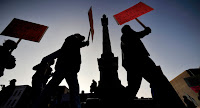
Thousands of protestors took to the streets this past week—in Wisconsin. They were protesting legislation that would restrict the scope of collective bargaining power, while at the same time requiring public-sector workers to pay more for their pensions and health care. Last week, reportedly 40% of Madison, Wisconsin, schoolteachers called in sick (ostensibly they were in attendance at the state capital, and by appearances bringing some of the student body with them). The protestors (at least the ones on camera) drew comparisons to their actions with those taken recently by those in Egypt protesting for freedom and a democratic system of government. But to my eyes, it looked more like Greece. Don’t get me wrong. The Wisconsin protests were boisterous but appeared to be peaceful, and I’ve heard no reports of the kind of violence and arson that accompanied the protests in Greece a year ago (see Grecian Formula ). But in Wisconsin, as in Greece, a big issue is pensions and benefits 1 ...

“Pressure” Point

Image
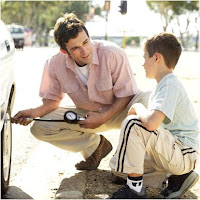
Last week, I got an early morning call from my daughter. This, of course, is not an everyday occurrence, and since she had driven MY car to work that morning, it didn’t bode well as a start to the day for either of us. Turns out, she had noticed an unusual warning light as she pulled into her workplace—and she had even taken the time to determine its meaning. The good news is, the light indicated nothing more serious than low pressure in one (or more) of the tires. Now, my vehicle routinely prompts me for certain scheduled maintenance visits—many of which I ignore/postpone since they seem mostly designed to keep me spending money at the dealer. Unfortunately, the last time this particular light came on, it was a somewhat belated acknowledgement that one of my tires was flat. Consequently, on this particular occasion, I immediately jumped to the conclusion that we were dealing with a flat tire. By the time I got to the car (fortunately, it was sitting in a parking lot on a brillian...

Projection Screen?

Image
More than the subtleties of the law, the nuances of crafting a cogent legal brief, and the humiliations that often accompany the public exercise of the Socratic method, surely the most intimidating aspect of my law school experience—certainly in the first year—was the grading. In the vast majority of my classes, there were no papers, no mid-term, no pop quizzes; in fact, no tangible means of measuring progress vis-à-vis the expectations of the course. Indeed, in the vast majority of courses, it came down to a single final exam (and an essay exam at that). Now, there were regular (and, as I recall, fairly prodigious) reading assignments—and there was the omnipresent “fear” of being called on to explain the legal intricacies of a particular case—but, for the very most part, lacking any specific interim evaluations, there were weeks when the press of external events intruded. It was, for some of my classmates, particularly in that critical first year, easy to postpone their preparatio...

The Mean-ing of Average

Image
As if retirement savers didn’t have enough problems, last week Fidelity Investments reminded us how much money we’re going to need for health care. According to Fidelity’s annual estimate, an average couple retiring in 2009 would need $240,000 set aside by age 65 in order to pay for health-care expenses in retirement (see “ Retiree Health Care Estimate Jumps 6.7% ”). Worse, that’s up from $225,000 in 2008—and even worse, the 2009 figure is 50% higher than the $160,000 Fidelity estimated in 2002 would be required. Even those workers who still have employment-based retiree health benefits to supplement Medicare, but who must pay their own premiums, need to set aside a hefty amount, according to a 2008 EBRI report; men would need between $102,000 and $196,000 in current savings (50th and 90th percentiles, respectively), while women would need between $137,000 and $224,000, respectively, due to their greater longevity, according to the report (see “ EBRI Pinpoints Retiree Health Expenses ...