Posts

Goals Tending

Image
The bad news is that times are still tough for many Americans—and surveys suggest that even those with jobs are nervous about their prospects for the future. The good news is that the current level of economic uncertainty seems to have brought about—at least for some—a heightened awareness of the need to set money aside for a rainy day, perhaps even those rainy days in retirement. That said, the weak economy has certainly constrained the ability of many to save. In fact, a recent national survey found that an increasing number of Americans are having difficulty saving to meet goals ranging from meeting emergencies to affording retirement. The survey—released as part of America Saves Week(1)—noted that over the past three years, there has been a decline in the number of people who spend less than their income and save the difference, are building home equity, have adequate emergency savings, and think they are saving enough for retirement. However, the survey also revealed that havi...

“Short” Comings

Image
In this business you are frequently asked “how much should people save for retirement?” Some try to answer that question with a degree of specificity that can be somewhat simplistic. Let’s face it, even if those close enough to retirement to have a sense of what their pre-retirement income level is (and, flawed as that can be, most projections start from that assumption as a baseline for what you’ll want/need to spend in retirement—see “Replacement” Window ), most struggle to turn that into a real savings figure. Ultimately, of course, a reliable answer to that retirement savings question requires an understanding of the individual’s goals and/or financial needs—and, predicated on certain assumptions, there are any number of tools that can help individuals set a target and (based on that) establish a savings plan. However, the planning question that almost never gets asked is: “And how certain do you want to be of achieving that target?” Asked that question, I suspect most ind...

Road "Construction"

Image
The Senate Finance Committee is positioned to pass a highway bill, funded at least in part by changing the tax treatment on retirement accounts. Specifically, the modified chairman’s mark of the proposed Highway Investment, Job Creation and Economic Growth bill would require that age 70-1/2 account distributions be treated, for tax purposes, as distributed within five years of the death of the account holder (unless the beneficiary is the account holder’s age, a child with special needs, or older than 70). Under current law, holders of IRAs and 401(k)-type accounts are required to begin taking taxable distributions from those accounts once they reach age 70-1/2, though if the account holder dies, the taxation of the account is spread over the life of the beneficiary. According to a Senate Finance Committee press release , this particular provision is estimated to raise $4.648 billion over 10 years. The bill’s prospects in the Senate remain unclear, and the Wall Street Journal no...

Above “Average”

Image
Every so often an industry survey will come out with an “average” 401(k) balance (1) . The specific numbers vary, but they are consistently less than even the most optimistic would see as sufficient to provide a financially viable retirement. Now, in fairness, the validity of an “average,” while mathematically simple, depends heavily on its components. Most are no more than the total of all the balances of those in the 401(k), from those just entering the workforce (and thus, by definition, with negligible balances) – and with decades to go to retirement – to those who are perhaps just days away from that point. Looking at no more than the “average,” you can’t tell how many are in which category. So, while the average can, over time, provide a sense of the direction in which things are moving, it tells you very little about the adequacy of that savings to fund an individual retirement. One way to help provide a more meaningful measure is to segment those balances by specific ag...

Pats or Giants? Your Portfolio May Care

Image
There could be a lot more riding on Sunday’s Super Bowl than you think. If the results of the Super Bowl exert any influence on the markets – as proponents of the so-called Super Bowl Theory claim – then 2012 could prove to be truly tumultuous. For the "uninitiated," the theory (invented/popularized by the late New York Times sportswriter Leonard Koppett) says that a win by a team from the old National Football League is a precursor to rising stock values for the year (at least as measured by the S&P 500), but if a team from the old American Football League (AFL) prevails, stocks will fall in the coming year. This year we have a team from the old NFL (the NY Giants) taking on one from the old AFL (the New England Patriots, who once were the AFL’s Boston Patriots). So, if the Giants prevail, 2012 should be a good year for stocks – and if things go the Patriots’ way, well… On the Other Hand… Of course, as even loyal proponents will admit, this theory used to work...

“Essential” Information

About a month ago, the Department of Health and Human Services (HHS) released a bulletin outlining proposed policies that it said would “give states more flexibility and freedom to implement the Affordable Care Act.” It did that by proposing to allow individual states to select a single benchmark to serve as the standard for qualified health plans inside the Exchange operating in their state – and for the plans offered in the individual and small group markets in their state. The Patient Protection and Affordable Care Act requires that health insurance plans offered in the individual and small group markets, both inside and outside the ”Affordable Insurance Exchanges” (Exchanges), offer a comprehensive package of items and services, known as “essential health benefits (1) .” This benchmark would set the standard of the items and services included in the essential health benefits package called for in PPACA (2) . Acknowledging that “[t]There is not yet a national standard for p...

Replacement “Window”

Image
There is an old adage that cautions about the consequences “when you assume…” And yet, the business of retirement planning is replete with any number of so-called “common wisdom” rules of thumb. Doubtless many have well-intentioned origins – to make complicated concepts easier to grasp, and thus to address. One of the more pervasive notions is that a realistic target for retirement savings can be determined by accumulating a sum that will provide an income stream equal to a percentage of one’s pre-retirement earnings – a sum that is generally expressed as 70-80% of what you earn prior to retirement. This starting point - generally called a "replacement ratio" - includes any number of imbedded assumptions, perhaps most significantly that the individual will need to spend less post-retirement, generally understood to be on things such as taxes, housing, and various work-related expenses (including saving for retirement). Moreover, the replacement rate approach represent...

'Under' Covered?

Image
One of the more pervasive statistics bandied around about the voluntary retirement system is that only about half of working Americans are covered by a workplace retirement plan. It’s a data point that is widely and openly presented as fact—not only by those inclined to dismiss the current system as inadequate, but even by some of its most ardent champions, who see that result as a call to action for expanded access to these programs. There’s only one problem: It doesn’t tell the whole story. A 2011 EBRI report found that in 2010, 77.6 million workers worked for an employer/union that did not sponsor a retirement plan and 91.0 million workers did not participate in a plan. However, focusing in on employees who did not work for an employer that sponsored a plan, 9.0 million were self‐employed. Of the remaining 68.5 million: • 6.2 million were under the age of 21, and • 3.7 million were age 65 or older. • 32.0 million (approximately) were not full‐time, full‐year worke...

Pension Penchants

Image
On Dec. 8, the Pension Benefit Guaranty Corporation (PBGC) convened a forum on “the Future of Pensions.” The forum was structured around two separate panels of experts (including EBRI President and CEO Dallas Salisbury) who spoke to an audience of pension industry thought leaders on the current retirement landscape, as well as potential enhancements and solutions. Among the insights/observations shared in the session: • In 1975, among those over age 65, 23 percent had pension/annuity income; in 2010, that had risen to 33 percent. • According to EBRI’s Retirement Readiness Rating (RRR) 57 percent of those under age 65 were considered to be at risk of not having sufficient retirement resources to pay for “basic” retirement expenditures and uninsured health care costs, a figure that had declined to 45 percent in 2010. • In fact, a world in which 30-year job tenure (and associated pension benefit) was never a reality for 80 percent of the nation’s workers. Rather, it was a myth...

Conversation "Starters"

Image
While the headlines out of our nation’s capital are driven by talk of the looming budget crisis, concerns about the sluggish economy, and the impending 2012 elections, discussions about retirement, retirement savings, and ways to improve retirement savings have been the order of the day here in Washington. The Women’s Institute for a Secure Retirement (WISER) recently convened its Annual Women’s Retirement Symposium, with a focus of the future of retirement (broadly defined) and the specific implications for women (who live longer, are frequently paid less than men, and whose working careers often include family interruptions in pay and savings). EBRI data surfaced in a number of presentations throughout the event, including references to gender participation rates (see http://www.ebri.org/pdf/FFE.192.21Mar11.RCS-Gender.Final.pdf , http://www.ebri.org/files/FS4_RCS11_Gender_FINAL.pdf ), as well as differences in retirement confidence, and men’s and women’s response to opportunities s...

SURVEY SAYS…

Image
One of the things I enjoyed most about writing/publishing NewsDash over a 16-year span (12 years at PLANSPONSOR, and four before that as an internal email) was doing a weekly survey – on a wide variety of topics, both serious – and not-so-serious. My favorite of the “regular” surveys (and there weren’t many that repeated, even over all that time) was the annual survey of holiday movies. And while there were certain perennial favorites, it seemed like every year there was a real “battle” for the top slot among readers. As for this year – well, the survey was admittedly a bit ad hoc – but the results were just as fun. So, here’s the top 5: Christmas Vacation (26.1%) It’s a Wonderful Life (15.2%) Elf (13.0%) How the Grinch Stole Christmas (4.3%) A Charlie Brown Christmas (4.3%) …asked to choose a second favorite, It’s a Wonderful Life and Elf tied for first, with 14% of the vote. You can check out the NewsDash survey from 2010 at http://www.plansponsor.com/SURVEY_SAYS_What_is_Your_Fa...

Naughty? Or Nice?

Image
Editor’s Note: There’s so much going on in the world of retirement saving and investing that I never feel the need (or feel like I have the opportunity) to recycle old columns – but this one has a certain “evergreen” consistency of message that always seems appropriate – particularly at this time of year. A few years back—when my kids still believed in the reality of Santa Claus—we discovered an ingenious Web site. This was a Web site that purported to offer a real-time assessment of your "naughty or nice" status. Now, as Christmas approached, it was not uncommon for us to caution our occasionally misbehaving brood that they had best be attentive to how those actions might be viewed by the big guy at the North Pole. But nothing ever had the impact of that Web site - if not on their behaviors (they're kids, after all), then certainly on the level of their concern about the consequences. In fact, in one of his final years as a "believer," my son (who, it must ...

Thanks Giving

Image
After a dozen years here at PLANSPONSOR, effective November 1 , I have joined the Employee Benefit Research Institute (EBRI) in Washington, D.C., as Director, Education and External Relations, and Co-Director of the EBRI Center for Research on Retirement Income. I have long had a strong personal and professional admiration for the work that EBRI does in helping provide our industry with valuable and objective information and am thrilled to be able to be part of those efforts at this critical juncture. It has been my great privilege over this past decade and change to share with you some of my thoughts and observations in this space. You have been generous both with your comments and commentary on those musings, as well as our publications overall. While it’s not quite Thanksgiving, I thought I would dedicate this final “IMHO” to sharing some of the things for which I’m thankful: I’m thankful that the vast majority of plan sponsors continued to support their workplace retirement prog...

Lessened, Learned?

Image
When I’m talking to plan sponsors (and advisers) about the challenges of being an ERISA fiduciary, I’m generally inclined to emphasize the awesome responsibilities that come with the “assignment”: the impact exerted on participant retirement savings; the admonition to ensure that fees paid by, and services rendered to, the plan are reasonable; the implications of the prudent expert rule; and the liability (and personal liability, at that), not only for your own acts, but for the acts of your co-fiduciaries (and hence an urgency around knowing who those co-fiduciaries are). I’m inclined to talk about the limitations of ERISA 404(c) in providing a shield against all that potential liability. I’ll remind them that the Labor Department considers them responsible for all participant-directed investments outside 404(c)’s provisions, and note how frequently participant directions tend to fall outside those provisions. I’ll tell them how important it is to read the plan document, and to make...

IMHO: Catching Your Drift

Image
I recently found myself driving in an unfamiliar city without the aid of a GPS (global positioning system). Sadly, I had become so accustomed to having that device available, I hadn’t even taken the time to print out instructions from any of the usual Internet sources, and while there were maps in the vehicle, none were of the area in question. That didn’t matter, I told myself—because I had made that drive before, had a pretty good idea of where I needed to be and, armed with a pretty reliable memory for such things, I set out with only a little trepidation. Just about the time I was getting pretty confident in my ability to navigate without all the high-tech “crutches,” I was thrown a series of curves. The primary route was closed due to construction, the rerouting didn’t seem to take into account where I was trying to get to, an unexpected one-way street suddenly emerged going the “wrong” way, and then I found myself directed onto a parkway whose designers had apparently never co...

The IKEA “Experience”

Image
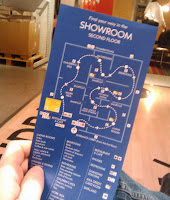
We spent some time this past weekend getting my eldest daughter squared away in her new apartment. It’s her first, and as with nearly all first apartments, there is a lot you need to get that you never needed in your room at home or in your dorm away at college. So we headed out to IKEA. Those who have never had occasion to visit an IKEA store should check it out at least once. They are mammoth stores—big on the outside and seemingly even more massive on the inside. It’s the kind of store you can easily get lost in (not to worry, they have their own food court inside), and yet it’s very hard to simply get from point A to point B, even if you know what you want to buy. About the only way to get through the store is to wander along the winding path the IKEA folks have constructed that takes you—literally—through every display imaginable.1 But the really interesting thing about the IKEA shopping process is that you not only have to find what you want, you must write down the part n...

“Nigh” Five

Image
A few weeks back, I offered some notions about what the next five years will bring in terms of industry trends (see “ IMHO: Fifth ‘Avenues’ ”). However, in preparing for our recent PLANADVISER National Conference, I came up with five more. Everybody isn’t going to do automatic enrollment. Without question, automatic enrollment has done much to shore up the retirement savings rates of American workers. For plan sponsors and participants alike, the efficacy of an approach that doesn’t require participants to complete an enrollment form, deliberate over investment choices, set upon a desired rate of savings, or even darken the door of an education meeting has done much to get tens of thousands of workers off on the right retirement savings foot. And, for the vast majority of workers, the ability to do the right thing without doing anything at all has not only been well-received, but much appreciated as well. Not that automatic enrollment as outlined by the Pension Protection Act (PPA)...

“Better” Business

Image
There was another judicial decision in another revenue-sharing case earlier this month—and another victory for a plan sponsor. The case was Loomis v. Exelon (see Another Plan Sponsor Win on Revenue-Sharing ), a case argued before the 7th U.S. Circuit Court of Appeals, which had previously weighed in on the case that appears to be setting the tone in most of these cases, “Hecker v. Deere & Co.” Hecker, as you may recall, involved a situation with a large, multi-billion-dollar plan that offered its participants access to a couple of dozen funds from a single provider alongside a self-directed brokerage window that afforded access to funds beyond that. The 7th Circuit dismissed that challenge, finding that the competitive forces of the market were sufficient to ensure reasonable fee levels for the specific funds on the menu, and that, if the participants felt otherwise, they could always pursue other options via the brokerage window. In Exelon, there was no brokerage window, though ...

IMHO: Working “Outs”?

Image
Last week the Senate Finance Committee held a hearing on “promoting retirement security.” While options were presented to improve things (see “ Industry Groups Urge No Changes to Retirement Savings Tax Advantages ”), the discussion quickly veered toward a debate on whether and how well—or poorly—the current system is working. That said, listening to the witnesses, 1 one might well have thought they were discussing completely different systems—from one that is striking a good balance between incentivizing employers and encouraging participants to one that is all about providing tax benefits for saving to those who don’t require such enticements; from one that is putting too much responsibility on individual savers to one that has managed to, on a voluntary basis, draw the support of roughly eight in 10 workers. One that has failed, and seems unlikely to ever deliver a real retirement income solution—or one that has the potential to make that a reality. Metrics Systems As always, the...

“Back” Pay?

Image
During last week’s GOP presidential candidate debate, Texas Governor Rick Perry grabbed headlines by reaffirming his position that Social Security is a “Ponzi scheme.” Pundits were quick to jump on the comment, apparently believing that such rhetoric will “spook” the electorate (specifically older and independent voters) and ultimately make Perry unelectable, while purists were quick to point out the distinctions between the operation and intent of the two approaches, apparently believing that the technical distinction would matter (to anyone besides purists). True, a Ponzi scheme, such as the one Bernie Madoff ran, as well as Charles Ponzi’s original design, is positioned as an investment. Investors hand over money to someone, believing that their money will be invested and grow. Instead, the scheme “runner” generally pays off longer-term participants with money invested by newer investors. Sooner or later, there are not enough new investors to fulfill those expectations and the wh...