Posts

How the Class of 2020’s Retirement Plans Will Be Different

Image
Each year the good folks at Beloit College produce a “Mindset List” providing a look at the cultural touchstones that shape the lives of students about to enter college. So, in what ways will their retirement plans differ from those of their parents? In the most recent list (they’ve been doing it since 1998), the Beloit Mindset List notes that for the class of 2020 (among other things): There has always been a digital swap meet called eBay. They never heard Harry Caray try to sing during the seventh inning at Wrigley Field. Vladimir Putin has always been calling the shots at the Kremlin. Elian Gonzalez, who would like to visit the U.S. again someday, has always been back in Cuba. The Ali/Frazier boxing match for their generation was between the daughters of Muhammad and Joe. NFL coaches have always had the opportunity to throw a red flag and question the ref. Snowboarding has always been an Olympic sport. John Elway and Wayne Gretzky have always been retired. So, what abo...

Boiling Points

Image
One could hardly read the headlines this past week without experiencing a certain sense of déjà vu. After all, it’s been not quite 10 years since the then relatively obscure St. Louis-based law firm of Schlichter, Bogard & Denton launched about a dozen of what have come to be referred to as “excessive fee” lawsuits. Not that the recent batch of suits targeting multi-billion dollar university plans are a mere recounting of the charges leveled against their private sector counterparts. No, in the years since then the Schlichter law firm has sharpened their pencils, and their criticism. Those early suits focused on what, in comparison to the most recent waves, seem almost quaintly simplistic: allegedly undisclosed revenue-sharing practices, the use of non-institutional class shares by large 401(k) plans, the apparent lack of participant disclosure of hard-dollar fees (which even then were disclosed to regulators), and even the presentation of ostensibly passive funds as actively ...

5 Ways Industry Surveys Can Be Misleading

Image
As human beings, we’re drawn to perspectives, including surveys and studies that validate our sense of the world. This “ confirmation bias ,” as it’s called, is the tendency to search for, interpret, favor, and recall information in a way that confirms our preexisting beliefs or hypotheses. It also tends to make us discount findings that run afoul of our existing beliefs. In its simplest terms then, when you see a headline that confirms your sense of the world, you’ll be naturally inclined to embrace and remember it as a validation of what you already perceive reality to be. Even if the grounds supporting that premise are shaky, sketchy, or (shudder) downright scurrilous. Here are some things to look for – likely in the fine print – as you evaluate those findings. There can be a difference between what people say they will (or might) do and what they actually will. No matter how well targeted they are, surveys (and studies that incorporate the outcome of surveys) must rely on w...

A Pension Protection Perspective

Image
It’s hard to believe, but the Pension Protection Act of 2006 will be a decade old next month. And it’s probably done more good for the nation’s retirement security than most realize. The PPA drew its name from the portions targeted at shoring up defined benefit plans (and PBGC funding, I suppose), though at the time I remember most people thinking it was an ironic name, in that it may have been intended to secure the pensions that were already in existence, but might well accelerate the demise of some on the cusp, and in any event was unlikely to help spur any new growth in that area. Some went so far as to call it the Pension Destruction Act. Indeed, at a recent panel session featuring the perspectives of a number of the Hill staffers who shepherded the at times controversial legislation through its passage, the emphasis was largely on the DB aspects that, though well-intentioned, had been overwhelmed (if not undermined) by the onset of the 2008 financial crisis and the “histor...

3 Things Retirement Savers Can Learn from Pokémon Go

Image
If you’re a Millennial (or know one), you’ve surely heard about (or seen in action) the recent outbreak of Pokémon Go . It’s not even a week old, but it’s quickly dominating social media. If you’ve managed to avoid the media barrage, it’s a new (free) interactive online game that builds on the basics of the Pokémon card and video games past – catching Pokémon, battling at Gyms, using items, evolving your creatures. These creatures (151 unique ones at present) have even been spotted hanging out with a certain renowned ERISA attorney (see below)! The object of the game is to find these Pokémon (they’re fictional animals – the name is said to be from a contracted Romanization of the Japanese Poketto Monsuta, a.k.a. “pocket monsters”), and then catch them, by throwing a sphere called a Pokéball in their general direction, after which they can grow via battles with other Pokémon in Gyms, and then do battles with still yet more Pokémon in Gyms, etc. All of which is to the benefit of thei...

4 Things Plan Fiduciaries Have in Common With the 2nd Continental Congress

Image
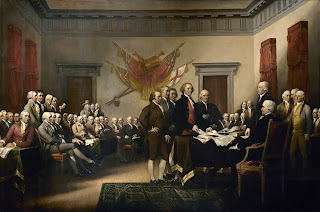
Anyone who has ever found their grand idea shackled to the deliberations of a committee, or who has had to kowtow to the sensibilities of a recalcitrant compliance department, can empathize with the process that produced the Declaration of Independence we’ll commemorate on the Fourth. That said, I think there are things that today’s investment/plan committee share with, and can learn from, the experience of those forefathers who crafted and signed the document declaring our nation’s independence. It’s hard to break with the status quo. By the time the Second Continental Congress convened, the “shot heard round the world” had already been fired at Lexington, but many of the representatives there still held out hope for some kind of peaceful reconciliation, even as they authorized an army and put George Washington at its helm. Little wonder that, even in the midst of hostilities, there was a strong inclination on the part of several key individuals to put things back the way they h...

Your Plan Might Be an Excessive Fee Litigation Target If…

Image
Last week another of the so-called excessive fee lawsuits was settled – not adjudicated, mind you. Here are some factors that the targets of these lawsuits seem to have in common. Now, in fairness, most of these cases haven’t actually gone to court – and, by my count, most of the ones that actually get to court are won by the employers/plan sponsors. Even the Tibble case , which drew so much attention when it made it to the Supreme Court, eventually came out in favor of the plan sponsors (though they “lost” the Supreme Court decision). However, a lot of litigation has been filed over the past decade, and millions of dollars spent — reminding me of an old mentor’s admonition that you can spend a lot of money in court being “right.” That so many employers have decided that it is “cheaper” to settle for millions of dollars gives you some idea of the magnitude of these challenges. So, with that in mind – and with apologies to Jeff (“you might be a redneck…”) Foxworthy: Your plan m...

Oliver's 'Twist': 5 Takeaways

Image
I’ve long enjoyed John Oliver’s take on the world. He has a gift for bringing humor to subjects that aren’t generally seen as funny, and in the process not only helps make complex topics more approachable, he gives voice to the frustration that millions surely feel at the world around us. That said, when he decides to weigh in with his style of biting commentary on  your  profession – well, let’s just say that you’re likely to be in for a bumpy ride. And so it was this weekend,  when he took on  retirement savings, retirement advisors and the process of setting up a small plan 401(k). Now, it wasn’t as biased as some media treatments of the retirement plan profession have been. Oh, they brought in the exaggerated math on fees from that  2013 PBS Frontline special , copied (and doubled down on)  their dismissal of active management  …and he  did  reference  termites . But all in all – and while continuing to emphasize throughout th...

A Fiduciary ‘Idiot Light’

Among the assorted “idiot lights” that adorn my current car dashboard is one that alerts me to low tire pressure. It’s come in handy on precisely two occasions – one when a nail had punctured my tire (though I had already discerned that I had a problem from the sound of the flat tire nanoseconds before the light came on); the other when I had neglected to keep an eye on the tire pressure (which coincided with a day that I had let my daughter take my car to work). Other than that, it’s never really been on or an issue – or a help – until recently, when it came on, and stayed on, about 100 miles from home. Now my owner’s manual suggested that this behavior might be a sign of a bad sensor, and sure enough, (after 100 miles of driving angst) that was subsequently confirmed by my mechanic – who also informed us that it would cost a couple of hundred dollars to replace it. Perhaps needless to say, that light continues to illuminate my dashboard. Since the initial flurry of so-called “e...

The Deification of DB-ification

Image
I recently stumbled across another of those “DC plans are becoming like DB plans” articles — you know, the so-called “DB-ification” of 401(k)s? This is all supposed to be a good thing, of course, but is it? We are, of course, routinely told that defined benefit plans do (or did) a better job of providing adequate income in retirement than defined contribution plans — though we aren’t generally reminded that that assumes that workers have actually managed to accumulate service credits sufficient to vest in those benefits, and that those programs are properly funded. However, this interest in emulation of DB plans by DC plans is a relatively recent focus, fueled in no small part by the success of Pension Protection Act-engendered trends, primarily auto-enrollment (after all, nobody asks people to fill out a form to be covered by their DB plan) and asset allocation fund defaults (ditto on asking participants to choose the investments in the DB plan). But while it’s said that imitation...

Did We ‘Need’ a New Fiduciary Regulation?

Image
I was recently asked by a reporter if the new fiduciary regulation was “needed.” The question caught me a bit off guard, because having been in “figure out how to deal with this” mode for most of the past year, I had long since moved past “why” and “if” to “when” and “how.” I was reminded of our last home purchase – which we bought in a bit of a rush. Oh, it wasn’t like we didn’t know we were moving – but our ability to actually hone in on a new home was hindered by the fact that our current home had to sell first. And, as is often the case in such things (or has been for us), we had gone a long time with nary an offer, much less a viable one. Once that offer came, of course, we had to move quickly (literally). And so, the planning that we had done mentally in anticipation of that day was thrust into overdrive. Ultimately we settled on a house that wasn’t the best we had seen, but it was the best available at the time (within the price and commuting distance restraints we placed up...

5 Reasons to Plan and Save for Retirement Now

Image
As April is National Financial Literacy month, and this is National Retirement Planning Week, those who work with retirement plan participants know it’s important to do the right thing(s) when it comes to retirement planning and savings. But for those you are trying to help encourage, here are five reasons to plan and save for retirement now, and as an integral part of that financial plan. Because you don’t want to work forever. Seriously, no matter how much you love your job, if you want to stop working one day – and trust me, you will – you are going to have to think about how much income you will need to live after you are no longer working for a paycheck. Because living in retirement isn’t “free.” Many people assume that expenses will go down in retirement – and, for many, perhaps most, they do. On the other hand, there are changes in how we spend in retirement as well – and they aren’t always less. A recent report by the nonpartisan Employee Benefit Research Institut...

The Choices of a Lifetime

Image
It was 10 years ago today – a Saturday morning as I recall.   I had just wrapped up my weekly column when I got a call from my sister. My father, who had been battling cancer for several years now, had suffered a series of heart attacks. By the end of the day, he had passed. As the family converged, my siblings and I tried as best as we could, together with Mom, to deal with the tasks that required our attention, and divvied up the ones that seemed to call out for individual attention. Having spent my entire professional career in financial services, and having picked up a law degree along the way, my “job” was to organize the will and assets. The estate wasn’t complicated.   My parents each chose careers of service to others; Dad as a minister, and then a director of missions where he helped other ministers until his “official” retirement several years ago (far as I could tell, Dad’s only retirement was from the receipt of a regular paycheck), while Mom was a school tea...

The ‘Plot’ Thickens

Image
In recent weeks, I have been distressed to see a pair of reports by what are sometimes affectionately referred to as 401(k) “haters” — but that’s not what I find most troubling. One, by the Economic Policy Institute, is innocuously titled, “ The State of American Retirement ,” but it might be more honestly subtitled, “How 401(k)s have failed most American workers.” The other is a formalized (and slightly updated) version of Teresa Ghilarducci’s Guaranteed Retirement Account (GRA) proposal titled, “ A Comprehensive Plan to Confront the Retirement Crisis .” Both reports tread familiar, and misguided, ground. Misguided and misleading as these kinds of reports are, they’re not new or even original. I’d almost be inclined to simply ignore them. That is, until I see headlines like, “ The Plan That Could Render Your 401(k) Obsolete ,” or “ These Depressing Charts Show the Different Ways 401(k)s Fall Short ,” reported with a straight face by the personal finance press. The latter, which ju...

5 Ways to Boost Retirement Confidence

Image
With increasing regularity, the financial services industry pumps out surveys that purport to capture America’s sense of confidence regarding its readiness for retirement, at least on a financial footing. Mostly, however, they seem to focus on the symptom, rather than dealing with the underlying cause(s). However well-intentioned, these all seem designed to highlight a persistent strong undercurrent of concern — one that, certainly when juxtaposed against the generally disappointing preparation levels reported by respondents, seems completely warranted. Confidence about retirement is one thing, of course, and preparation something else, though the two are logically intertwined. That said, for those looking to shore up confidence levels, data from the granddaddy of such surveys — the non-partisan Employee Benefit Research Institute’s (EBRI) Retirement Confidence Survey — provides a roadmap: Work for an employer that offers a retirement plan. Data indicates that workers — even wo...