Posts

The ‘Better’ Business Bureau

Image
   The solution to the coverage gap lies through small business—but only about a third have been approached in the past year about offering one, according to a new survey. That’s not exactly a new revelation—any number of surveys and government data throughout the years indicates that the vast majority of large(r) employers already offer a workplace retirement plan. [i]  The coverage “gap” so often held out as a sign of “failure” by the critics of the 401(k) lies almost exclusively among smaller employers. Which means that closing it will require a focus on small business—and understanding the “resistance.”   At the outset, it’s worth acknowledging a certain truism about small plans (the kind small businesses set up)—they are sold, not bought. Consequently, it was disappointing to see that datapoint about just 31% of the businesses that do not currently offer a plan having been approached in the last 12 months about offering one. [ii]   That survey finding ...

Love and Money

Image
  How well do you (think you) know your significant other? The passage of time—shared experiences and the process of getting to know each other reveals much—and yet I learned something new about my partner of some four decades just last week! That brought to mind one of the favorite game shows of my youth was  The Newlywed Game . The show featured four couples—all of which were to have been married less than two years. Each of the contestant couples were separated—then asked a series of questions designed to test these newlywed couples’ knowledge of each other, and in some cases their collective memories (and willingness to share publicly). Points were assigned based on answers that matched—but the most memorable, of course, were the missed matches—and the inevitable response of the spouse who was absolutely CERTAIN of the response of their partner.   Now, a year of marriage is arguably not long enough to know EVERYTHING about your partner. But, and with Valentine’s ...

Could Your 401(k)’s Fate Rest on the Winner of Super Bowl 58?

Image
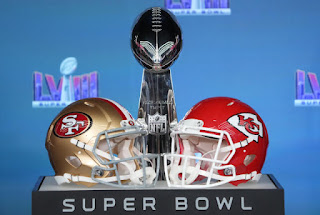
Will your 401(k) be chopped by the Chiefs—or find gold with the 49ers? That’s what adherents of the so-called Super Bowl Indicator [1] would likely conclude, after all. It’s a “theory” that when a team from the old National Football League wins the Super Bowl, the S&P 500 will rise, and when a team from the old American Football League prevails, stock prices will fall. It’s a “theory” that has been found to be correct nearly 80% of the time—for 41 of the 57 Super Bowls, in fact. Not that it hasn’t been tackled short of the goal line.  Portfolio Prognostications One needs to look back no further than last year’s victory by the (original AFL) Kansas City Chiefs that, according to the Indicator, should have predicted a portfolio predicament for the S&P 500—but wound up with a 25% gain for the year. Or the year before that when the victory by the Los Angeles Rams “should” have been a portent of good times, only to see the S&P 500 slump more than 19% for its ...

How to Craft a 401(k) Crisis

Image
Last week an article in an industry publication led with the title “401(k) experiment has failed, fueled U.S. retirement crisis, labor economist says.” In what I am sure generated a fair number of “clicks” that turned out to be the pronouncement of none other than Professor Teresa Ghilarducci, teeing up a new book [i] —one that she says aims to review the last 10 years of research by multiple entities on something she’s labeled the “liminal” period of life—that apparently intended to refer to an “intermediate” stage of life. According to the article, she is taking aim at certain assumptions that are made with regard to retirement investing/saving between the ages of 55 and 70. Bad assumptions, apparently. Now, considering that Professor Ghilarducci has written an entire book on this particular subject, extrapolation from a short interview about it (particularly when someone else did the interview) is a hazardous undertaking. But in that article —based on the upcoming ...

A ‘Cure’ Worse Than the Disease?

Image
Last week, a trio of academics rolled out a plan to “save” Social Security—by undermining the 401(k). Their “ plan ” is diabolically simple, though not unique. They’d just take away the tax preferences that support and encourage employment-based retirement plans—and “give” that money to Social Security.  It was admittedly an odd combination—Alicia Munnell, director and founder of the Center for Retirement Research at Boston College (which often has pretty negative things to say about the private retirement system [i] ), and Andrew Biggs, a senior fellow at the American Enterprise Institute, who has traditionally been a voice of reason on such matters—pointing to actual tax filing data to refute claims of a retirement crisis. Then again, Biggs, a former principal deputy commissioner of the Social Security Administration, and now a Senior Fellow at the American Enterprise Institute, has recently been nominated by President Biden to serve on the Social Security Adviso...

‘Nothing’ Doing About Social Security?

Image
Despite long being called the “third rail” of American politics, Social Security—or more precisely its viability—has reemerged as an issue in the 2024 presidential campaign. It came up most recently in a mini-GOP debate between former U.N. ambassador/South Carolina governor Nikki Haley and Florida governor Ron DeSantis. Haley reaffirmed her previous statements that changes would be required to shore up the financial viability of that system (and, arguably more critically, Medicare)—taking pains to emphasize that she wasn’t calling for changes that would impact current/close-to-retiring individuals.  For his part DeSantis—to whom the question was initially posed—maintained that there was no need to raise the age for full retirement benefits (apparently due to COVID’s impact on life expectancy), as though that were the only potential remedy required [i] (he did express confidence that something would be worked out long-term). And both former President Trump and Pres...

Is It (Finally) Finally Time?

Image
Two headlines on NAPA Net caught my eye this past weekend—provocative “what if” type questions. I’m talking about “ Will Retirement Income Solutions Finally Break Through in 2024? ” and “ Will Managed Accounts (Finally) Take Hold as QDIAs? ” Both, of course, included the word “finally” in the title(s)—no doubt because the underlying premise has been touted in previous years, but (mostly) come to naught.  And yet even now, both were basically based on predictions of organizations/individuals that have—as my friend John Sullivan put it—“a dog in the fight.” More specifically, the former finds heightened plan sponsor interest expressed (in an annuity-friendly trade survey)—and provisions in the original SECURE Act. And the latter finds a similar level of interest by plan sponsors in trading out target-date funds as QDIAs for managed accounts—on a premise that fees in the latter will decline and that recordkeepers will be able—and plan participants willing—to incorporat...

(Not-So) ‘Common’ — Wisdom

Image
There is a “common wisdom” in our business that suggests that all plan sponsors are, more or less, alike; that large plans are the inevitable early adopters of trends that, sooner or later, trickle down to plans of all sizes. Consequently, those who make their living trying to discern trends and patterns frequently focus on the behaviors in evidence at larger programs—figuring that, in three years or so, those same characteristics will emerge across the spectrum. There’s some logic to that perspective—and at least anecdotal evidence to support it. Human beings—including plan fiduciaries—frequently draw comfort and solace from the experience of others, and smaller programs can hardly be faulted for adopting plan designs and approaches that have been “vetted” by programs with more copious resources. Sure enough, there are areas in which larger programs once dominated—but over time those variances have disappeared. For example, according to the Plan Sponsor Council of A...

4 Fiduciary Resolutions for 2024

Image
  A brand new year awaits us – and with the New Year comes an opportunity to assess and reassess – for some when, resolutions for the cessation of bad behaviors and the beginning of better ones are in vogue. Here are some for plan fiduciaries for 2024 – that could benefit plan outcomes for years to come.  See if your target-date options are over-weight(ed)     Flows to target-date funds have continued to be strong – and little wonder, what with their positioning as the qualified default investment alternative (QDIA) of choice for most 401(k)s. That said, the vast majority of those assets are still under the purview of an incredibly small number of firms – nearly all of which (despite marketing brochures to the contrary) appear to share very similar views as to what an appropriate glidepath is supposed to look like – and nearly all of which have embraced the notion that a target-date is little more than a speed bump along the “through” target-date gli...